
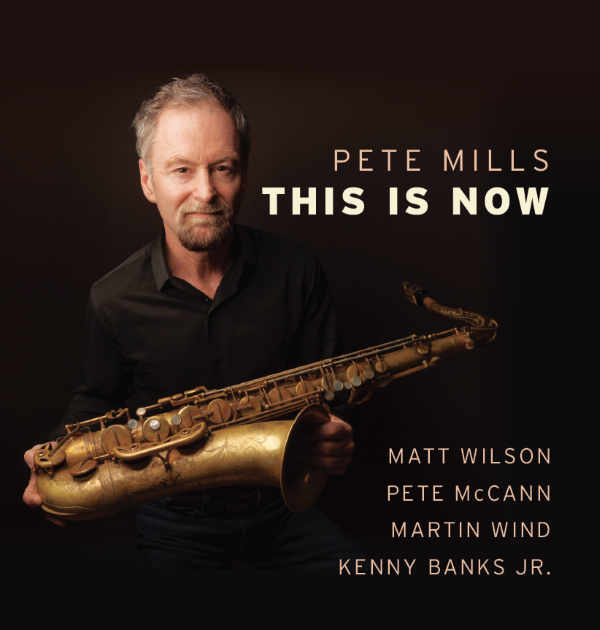
Blaise Lantana talked with Columbus, Ohio saxophonist Pete Mills about his new album "This Is Now" and his previous album "For The Record," as well as how he got into music, his educational work at Dennison University and the Ohio jazz scene. To read more about Pete Mills, visit his website at petemills.com
Transcript/Text Alternative
Transcript of Pete Mills Interview with Blaise Lantana
[0:00 - 0:34] [Music: “A Sliver of Silver” Upbeat modern jazz ensemble featuring a lively piano melody, crisp drum accompaniment, and a smooth saxophone solo with a medium-fast tempo]
Blaise Lantana: And that’s Pete Mills with A Sliver of Silver on Jazz PHX. He’s got a brand new release out. It’s called This Is Now with Kenny Banks Jr. at the piano. I’m Blaise Lantana and this is Jazz PHX, and guess what? Pete Mills is here with me to talk about this new album. Welcome, Pete!
Pete Mills: Oh, thanks, Blaise. It’s great to be here.
Blaise: And you, you did this tune, A Sliver of Silver. Is this because you’re a fan of Horace Silver? Are you a—
Pete: I am a fan of Horace Silver. I think that his music always has a kernel of kind of ear candy in it. Um, and so I tried to—well, I, in my music, I’m interested in finding those things uh, and trying to uh, do my best to to have a little bit of uh, something that’s familiar.
Blaise: Mhm, yeah.
Pete: Uh, and I love—I love Horace Silver’s music because it’s accessible and fun, there’s some joy, there’s a lot of joy in there. And then also, there’s depth, too. So, that’s kind of what I try to achieve when I can.
Blaise: Trying to create that balance. Now, you’re also a teacher. You are uh, you’re teaching jazz and saxophone?
Pete: Yes, I teach at a really nice little liberal arts college in uh, just outside of Columbus, Ohio called Denison University. And I teach uh, saxophone, I kind of coordinate the jazz studies area, and I work with some really talented students who do many things very well. Many of them will go on to be doctors and uh, economists and work in business, and also play music. So, it’s—it’s rewarding to kind of get them turned on to the music that we love, yeah, and go out in the world and play, and also uh uh, you know, be patrons and support the arts.
Blaise: Now, you did this album, This Is Now. What got you going on this particular work?
Pete: Well, I had a backlog of music that uh, I’ve been writing for a number of years, and along with some new things, and I it—it was time to document them.
Blaise: But you had just—wasn’t it last year you did For the Record? I did. And how was that one different from this one?
Pete: Well, For the Record is uh, it’s a—it’s a group of musicians that I play with, it’s a B3-based band. So, it’s a Hammond organ, kind of a groove Midwest organ groove type of a of a record. And that group uh, there’s a a little more of a collective when it comes to the compositions. We all put in different tunes for that one. This Is Now is uh, it’s basically all of my music, all of my compositions.
Blaise: All things that you’ve written, mhm.
Pete: Yes, and I wanted to document them, I wanted to play music with my—my friends Matt Wilson, uh, Martin Wind, and uh, Kenny Banks Jr. and from Columbus, and Pete McCann, the great guitar player who has been a part of my music since college. Uh, and I felt it was time to get the music out to the world.
Blaise: Cool. Now, have you worked much with Martin Wind? Because he’s got a new album out as well that we’ve been playing quite a bit.
Pete: He does. Oh, great! Marty is tremendous. Um, he’s a great musician, he’s got humor and and beauty in his playing and in his persona. And he and Matt play so well together, and they are uh uh, sort of part of the engine of this record, This Is Now, and also a record I did in 2013—2014 called Sweet Shadow. They both play on that.
Blaise: Well, let’s listen to the title cut so you can hear some of these cats that Pete Mills is talking about. I’m talking with Pete Mills. He’s a saxophonist, he’s an educator, and uh, and after this tune, we’re going to find out how he got to Ohio. Here’s Pete Mills from his brand new release, This Is Now, Kenny Banks at the piano, Pete McCann on guitar, Martin Wind, bass, and Matt Wilson playing the drums, on Jazz PHX.
[2:50 - 3:19] [Music: “This Is Now” High-energy modern jazz piece featuring dynamic saxophone hooks, fast-paced drumming, and intricate guitar work with a brisk tempo]
Blaise: That’s Pete Mills with This Is Now. That’s the title cut from his brand new release, with Matt Wilson playing the drums, Martin Wind, bass, Pete McCann, guitar, Kenny Banks Jr. at the piano. Pete Mills is playing that tenor saxophone for us today on Jazz PHX. I’m Blaise Lantana, and you’re in the right place. This is your 24-hour jazz connection, jazzphx.org. And now, you did not start in the Midwest though. You didn’t start in Ohio, which is where you live and work now. Wh—where did you start out?
Pete: Well, I grew up in Toronto, Canada, and uh, I finished high school in Toronto and then went to uh, college in Rochester, New York at the Eastman School of Music, and then also down to Denton, Texas and studied at uh, University of North Texas.
Blaise: Well, you got around.
Pete: I bounced around a bit. I lived in North Carolina, taught at a university there.
Blaise: You know what? I’m thinking that Eastman School of Music and uh, North Texas are two of the finest jazz education centers in the country outside of Berklee. So, how did you find those schools? How did you get there? Wh—what got you there from Toronto?
Pete: A little bit of luck, um, [laughs] a little luck. One of my—one of my high school teachers, uh, saxophone teachers, knew the saxophone professor Ray Ricker, who was my teacher at Eastman, and uh, my high school teacher was a a more of a con—concert saxophone teacher, uh, and I played a lot of classical saxophone as a as a youngster, and he suggested I do an audition. And I did an audition, and somehow, I was accepted and I convinced my folks that I needed to venture off across the border and go to college.
Blaise: Right. Wow. That’s kind of exciting. I—did you uh, play clarinet? Because classical saxophone, did you venture into the clarinet at all?
Pete: So, oddly enough, I did. I played clarinet uh, as an undergraduate, as a second instrument. I, you know, worked on my doubles. And when I went down to North Texas, I ended up studying uh, a woodwinds degree. I did a couple years where I had so much fun and played so much music and did very little coursework. [laughs] Uh, uh, it was great, it was part of uh, the best part of my life, having so much fun, yeah, and um, I had to wake up and finish college, graduate school, and I had enough credits to do a clarinet recital uh, and uh, I got a clarinet degree.
Blaise: Wow! [laughs] Wow! So, that’s pretty serious on the clarinet, but you don’t play it now? Not much. A little.
Pete: I double on the clarinet, but not like that, no.
Blaise: Hm. You know, it’s interesting to me what music students have to do, and you are—since you’re teaching—because you get one credit for the performance, [laughs] you know, then you have to take the three-credit class where you study theory, and it’s a—you’re spending all these hours practicing for one credit. It’s like [laughs] I think they are setting us up to stay in college for 20 years, I think. It seems. So, how do you deal with that with your students? Do they—do they say, "Man, I only get one credit for this class I’m taking and I have to put in all this time?"
Pete: Well, uh, you know, you have to love what you do, um, and if it’s just for a credit, then [laughs] you know, you might want to rethink it. But, but my students are are successful in lots of different areas. So, uh, we have really good fun, we make really good music, uh, and uh, then they go do incredible things that I can’t even imagine.
Blaise: Now, do you have a group? Do you have like a band, a big band with these guys that you work together?
Pete: In uh, my students?
Blaise: Mhm, yeah.
Pete: Yes, yes. At at Denison University, I uh, I direct the the large ensemble and then I also, we also have a combo, a small group that we focus on, you know, small group stuff. So, we work together, and we bring in guest artists. Pete McCann was uh, was my guest this uh, this past spring. We had lots of fun, he played with the band, and uh, we played some shows in Toronto, actually, up here, and then we went back down to Ohio and and played some shows, too.
Blaise: So, I’m—I mentioned that you made it to Ohio. How did—you just applied for the job there, and that’s why you moved there, or?
Pete: No, I um, I was living in North Carolina and uh uh, ended up um, moving to Ohio. Um, my girlfriend was was living there, and she became my wife, and uh, we uh, she had a job that that was really great, and I ended up getting a job in Ohio, and and every, you know, every few years, you get an opportunity to increase your teaching load, and I worked at Denison for quite some time, and then they offered me an opportunity to kind of be the coordinator and be more full-time. So, I’ve been there for a number of years.
Blaise: Wow. But you started out working in Toronto. Did you play much there when you were there? Because it sounds like you got out from there.
Pete: Well, oddly enough, in high school, uh, just, you know, learning. I did study with some really wonderful teachers, among them, great saxophonist Pat LaBarbera, who was with Elvin Jones, among uh Buddy Rich, and Pat is still here in Toronto and I saw him play recently and he’s still sounds remarkably amazing and beautiful.
Blaise: So, how did you get to jazz? Were your parents listening to jazz? Was there jazz at home?
Pete: My father was a fan of Louis Armstrong, uh, and Duke Ellington. He was a member of the Duke Ellington Society, and uh, he loved Billy Strayhorn, and that’s part of the reason, his love of the music brought it to me. And um, on almost all of my records, I include something by Strayhorn.
Blaise: Hm.
Pete: Uh, sort of as a—
Blaise: Tribute, yeah.
Pete: Tribute, yeah.
Blaise: Yeah. So, did he—did he have records, or how—what was he doing with it?
Pete: He had a great record collection, introduced me to uh, great uh, the Basie band. We—he took me out, I remember hearing the Basie band uh, just around close to my house, which I’m talking to you from right now. Uh, one of the great concerts of my life, um, I heard Oscar Peterson play solo piano uh, for over two hours in a auditorium in the summertime where there was no AC. Oh! [laughs] It was—it was crazy and remarkable, and I remember the feeling of of hearing him play.
Blaise: Right.
Pete: And my father was a—a super fan and uh, was at one of the great concerts uh, in Toronto at Massey Hall uh, where Charlie Parker, Dizzy Gillespie, uh uh, and so many others, Max Roach, and Mingus and Bud Powell played, and he has—he gave me Bird’s autograph from that night.
Blaise: Wow!
Pete: And I have, I cherish that.
Blaise: So, he was pretty serious about jazz, your dad. He was pretty—
Pete: He loved music. He, he was a remarkable influence in so many ways. And one of them was if, if he heard that something was important and interesting from someone he respected, he would venture out and check out what that was, and then decide. So, like bebop was not his thing, uh, Ellington was his thing, and Louis Armstrong. Those were the guys that he really knew a lot, and he loved big bands. Um, but, you know, bebop was an important thing at the time, and he went out and checked it out and became a fan.
Blaise: Wow. That’s a jump, that is a jump, yeah, from big band to to Charlie Parker.
Pete: Yeah, he loved the opera, and yeah.
Blaise: And he got you into it. So, I mean, so he’s playing the music around the house, the records are there, he encourages you. How does he support—and this is something I think that uh, people want to be aware of, is like, how do I support a child who’s getting into music? What kinds of things can I do besides, you know, say, "Hey, look at this school or look at that school"? How do you encourage them?
Pete: Well, you just want to—if you see a spark in your kid with whatever they do, you want to open up their world to that as much as you can.
Blaise: So, take them around to do things, or see things?
Pete: Sure! Yes, take them—if it’s—if it’s music, take them to hear the music live.
Blaise: Yeah.
Pete: And, you know, there’s—in in Columbus, Ohio, where I currently live, there are lots of great opportunities to hear jazz of all stripes live, uh, and you don’t have to be 21 at these places. I work for a non-profit organization in Columbus called Columbus Jazz, and uh, we have a big band, the Columbus Jazz Orchestra, and we play a series of concerts in Columbus uh, at a theater, we do about 50 shows a uh, 50 services a year, we do about 30 shows a year, um, and we have an education area that’s fantastic, and we do music uh, for high school kids, junior high kids, and then we even have uh, shows that we put on for preschool kids. So, there’s—
Blaise: There’s a lot. Well, you, you wrote this tune called Daddies. And I wa—I want to talk, after we hear the tune, I want you to talk about how you picked this title and how you put it together with your band. But right now, I’m talking with Pete Mills, and his new album is called This Is Now, Kenny Banks Jr., piano, Pete McCann, on guitar, Martin Wind, bass, and Matt Wilson is playing the drums. And one of the reasons I really wanted to do this interview and talk with you is because you are in the Midwest, because you’re not in New York City, because what I keep saying to people who are in New York City is, get out of there, and bring this music to everybody else in the country. Because I know it’s great to go hang out with all your friends and play your tunes with the best in the world, but you’re not getting the music to the people the way somebody who moves to a community, plays at the jam session, teaches at the college in Ohio, you know. So, I really appreciate that you’re there, that you’re doing that, and thanks to your girlfriend for getting there, getting you there, your wife now. Well, let’s listen to this tune. Here’s Pete Mills' tune, Daddies, on Jazz PHX.
[12:50 - 13:30] [Music: “Daddies” Funky and playful jazz arrangement with a driving bassline, rhythmic piano chords, and a soulful, bouncing saxophone lead with a moderate tempo]
Blaise: That’s Pete Mills from his new album, This Is Now, doing Daddies, with Matt Wilson on the drums, and Martin Wind, bass, and Pete McCann, guitar, Kenny Banks Jr. playing that piano, and Pete Mills on the tenor sax. His new album, This Is Now, is his music now. Tell me about how you picked this title for all these guys, Daddies.
Pete: Well, uh, I was writing some music, and I like to—you know you have a spark for an idea, sometimes it’s a music—musical idea, sometimes it’s just a a thought. Um, and I had some music that I was trying to write that—and I also was uh uh, playing, and I do play with some terrific musicians in Columbus who uh, were uh, becoming dads at the time. And I like to write music for my friends. Um, and this tune uh, has uh, a—l—it’s supposed to be kind of funny at times, have some uh tongue-in-cheek humor, and when we recorded it on the record, uh, all the guys in the band are dads, and uh, I just said, "You know, we got—we’ll have some fun with this because I know that uh, I always have fun playing with Matt and Martin and and Pete." Uh, and Kenny, uh, and I said, "There’s got to be a little chaos, too."
Blaise: [laughs] So, you put mixed that, put that in the mix.
Pete: A little fun, a little chaos, a little uncontrollableness, and a whole lot of love.
Blaise: This is—I’m talking with Pete Mills about his new album, This Is Now, and the tune we just heard, Daddies, on Jazz PHX. And you were talking a little bit about Charlie Parker. Now, you said you came up and you—your first degree was in classical clarinet, and then you came to jazz, or were you always playing jazz?
Pete: So, my first degree was actually in classical saxophone, and then I picked up the clarinet more seriously and got a a degree in classical clarinet in graduate school.
Blaise: Oh.
Pete: Um, yeah, and um, I—jazz has always something that I—that I was doing. These other things just kind of followed the path. Um, the clarinet got me down to North Texas, uh, and got me an opportunity for a scholarship to uh, play—I played bass clarinet in the wind ensemble, and the way they work things, they could give you a a very small scholarship at the time, but that gave you in-state tuition. And in-state tuition was—was minimal.
Blaise: Right, right.
Pete: So, the fun part, I played bass clarinet uh, in the wind ensemble, and there were two of us, and the other bass clarinetist was also a tenor player from Canada. [laughs]
Blaise: So—
Pete: So, we were living altered lives.
Blaise: Going—were you going out at night playing saxophone, playing some jazz saxophone?
Pete: That’s kind of what I was doing most of, yeah, trying to, [laughs] and trying not to disappoint my—my clarinet teacher was was terrific, and uh, he was uh, he he uh, he was very gracious at times when I’d come in not as prepared as I perhaps should have been because I was playing tenor.
Blaise: Sax. So, the—the thing about the clarinet, you know I hear saxophone players, and I can’t remember if it was Ernie Watts, it might have been, tell me that they never wanted to play the clarinet again because they, [laughs] you know, they loved the saxophone, that love affair didn’t seem to trans—transcend to the clarinet.
Pete: Clarinets are—I love playing the clarinet. I like playing more concert, quote-unquote classical clarinet than I do playing improvised music, because it’s really hard to play improvised music on the clarinet. Uh, and um, I love the sound of classical clarinet, it’s a beautiful sound. It’s in my ear. Um, I don’t do it that often. I’ll play some like Broadway shows and double on the clarinet. I enjoy it. It’s a challenge. I think saxophone players, we uh, uh you have to be a little more disciplined to play the clarinet, so we we sometimes shy away from it.
Blaise: So, when you have—with your students, do you encourage them to double, or do some extra things like that?
Pete: Sometimes, um, many of my students are doing music as uh something that they are doing purely for enjoyment, not necessarily as a career move. So, we kind of go where they have interests. Um, at times, I have students who are interested in in doubling, and I’ll teach them um, some clarinet.
Blaise: Maybe an alto or al—or go from tenor to alto?
Pete: Oh, yeah, yeah. I encourage my students to play all the horns. It’s great.
Blaise: Play all the saxes, yeah.
Pete: Because you never know—you never know the voice that you’re going to find. Um, I played mostly alto when I was uh a kid, and then I found the tenor uh, and it just felt like that was the sound in my ear. Huh.
Blaise: That was the one that just connected with your—with your heart while you played it. It just—
Pete: Yeah, it just—it feels right when—as in terms of a medium for expression. I love playing alto, and I, you know, I do play alto, playing alto next week in a few things. Um, but when I’m given an opportunity to play my music and to choose, I’ll—I’ll play tenor.
Blaise: All right. I’m talking with saxophonist Pete Mills. His album is called This Is Now, and he lives and works out of—what, where are you?
Pete: Columbus, Ohio.
Blaise: Columbus, Ohio. You can hear it with Kenny Banks, piano, Pete McCann, guitar, Martin Wind, bass, and Matt Wilson’s playing the drums. And I’m going to play one more song, and then we’ll come back and talk a little bit about uh Charlie Parker and saxophone and horn. Here’s Pete Mills doing Bird Lives on Jazz PHX.
[18:40 - 19:12] [Music: “Bird Lives” Fast and upbeat classic bebop jazz track with energetic saxophone riffs, quick drum hits, and a swinging rhythm section with a very rapid tempo]
Blaise: That’s Pete Mills with Bird Lives, and that’s from his album For the Record, which was just before this new one, This Is Now. Pete Mills is here with me in the studio talking a little bit about his music. And this previous record that you did, For the Record, uh, did you—you did that with your friends in Ohio, or your friends in Toronto? Where were you doing that?
Pete: Well, I have uh, one of the working bands that uh, I’m involved with is this B3 band, anchored by a great organ player named John Eshelman. Uh, John and the drummer Zach Compston uh, and Tom Davis and I, we have a group that’s kind of a collective in terms of the music we put in. So, for this record, For the Record, uh, we all contributed music uh, for uh, the layout of of the—of the the CD, the sound file, and LPs, we printed LPs for this one. Um, because we thought, it’s a organ record, it’s a little bit of a throwback.
Blaise: Right, right.
Pete: Thought that might be fun. Um, so this record is—it’s all—it’s original music and there’s some adventurous stuff going on and it all uh, it looks forward but it also looks back into this uh, this Hammond B3 tenor kind of tradition that’s very vibrant here in the Midwest even today, and it’s certainly a very important part of the history of of of American jazz music throughout the Midwest, the Chitlin' Circuit.
Blaise: Hm.
Pete: Uh, you know, there’s some great organ players from Columbus historically, uh, Don Patterson, Hank Marr, great organ player, and today, uh, John Eshelman is one of them, great Tony Monaco that you may know, he’s a good friend of mine. Uh, great organ player, and there’s a gentleman named Bobby Floyd, who’s also a—
Blaise: Oh, yeah.
Pete: —tremendous organ player and piano player. Bobby’s on one of my records and I play with him very regularly, too.
Blaise: So, this ne—what is this next tune? Who did this next tune, Step On It? Is this from—
Pete: That’s—that’s actually uh, one of another one of the compositions of mine uh, on the record. And I—when we were putting the music together, we needed a—we needed a blues. We needed something like a 12-measure straight up kind of blues tune, and we needed something that was a little peppy. So, I was driving to work, actually, on a stretch of highway that has great sightlines, uh, and I was testing out my car a little bit and—
Blaise: [laughs]
Pete: —this melody kind of came to me. So, that’s this tune, Step On It.
Blaise: All right, Step On It. We’re going to step on it with Pete Mills on tenor saxophone. This is from his album For the Record. And you can find her—find out more about Pete Mills, what he’s up to in Columbus, Ohio and around the country when you go to his website, petemills.com. And he’s going to maybe get the tune Daddies on the website, a little bit of video for you for Father’s Day. So, let’s listen now to Pete Mills, Step On It. Thanks for stopping by and talking with us here at KJZZ
.
Pete: What a great pleasure, thank you.
[22:36 - 23:22] [Music: “Step On It” Groovy and energetic jazz blues piece driven by a prominent organ baseline, brisk drumming, and a soaring saxophone melody with a medium-fast tempo]
[0:00 - 0:34] [Music: “A Sliver of Silver” Upbeat modern jazz ensemble featuring a lively piano melody, crisp drum accompaniment, and a smooth saxophone solo with a medium-fast tempo]
Blaise Lantana: And that’s Pete Mills with A Sliver of Silver on Jazz PHX. He’s got a brand new release out. It’s called This Is Now with Kenny Banks Jr. at the piano. I’m Blaise Lantana and this is Jazz PHX, and guess what? Pete Mills is here with me to talk about this new album. Welcome, Pete!
Pete Mills: Oh, thanks, Blaise. It’s great to be here.
Blaise: And you, you did this tune, A Sliver of Silver. Is this because you’re a fan of Horace Silver? Are you a—
Pete: I am a fan of Horace Silver. I think that his music always has a kernel of kind of ear candy in it. Um, and so I tried to—well, I, in my music, I’m interested in finding those things uh, and trying to uh, do my best to to have a little bit of uh, something that’s familiar.
Blaise: Mhm, yeah.
Pete: Uh, and I love—I love Horace Silver’s music because it’s accessible and fun, there’s some joy, there’s a lot of joy in there. And then also, there’s depth, too. So, that’s kind of what I try to achieve when I can.
Blaise: Trying to create that balance. Now, you’re also a teacher. You are uh, you’re teaching jazz and saxophone?
Pete: Yes, I teach at a really nice little liberal arts college in uh, just outside of Columbus, Ohio called Denison University. And I teach uh, saxophone, I kind of coordinate the jazz studies area, and I work with some really talented students who do many things very well. Many of them will go on to be doctors and uh, economists and work in business, and also play music. So, it’s—it’s rewarding to kind of get them turned on to the music that we love, yeah, and go out in the world and play, and also uh uh, you know, be patrons and support the arts.
Blaise: Now, you did this album, This Is Now. What got you going on this particular work?
Pete: Well, I had a backlog of music that uh, I’ve been writing for a number of years, and along with some new things, and I it—it was time to document them.
Blaise: But you had just—wasn’t it last year you did For the Record? I did. And how was that one different from this one?
Pete: Well, For the Record is uh, it’s a—it’s a group of musicians that I play with, it’s a B3-based band. So, it’s a Hammond organ, kind of a groove Midwest organ groove type of a of a record. And that group uh, there’s a a little more of a collective when it comes to the compositions. We all put in different tunes for that one. This Is Now is uh, it’s basically all of my music, all of my compositions.
Blaise: All things that you’ve written, mhm.
Pete: Yes, and I wanted to document them, I wanted to play music with my—my friends Matt Wilson, uh, Martin Wind, and uh, Kenny Banks Jr. and from Columbus, and Pete McCann, the great guitar player who has been a part of my music since college. Uh, and I felt it was time to get the music out to the world.
Blaise: Cool. Now, have you worked much with Martin Wind? Because he’s got a new album out as well that we’ve been playing quite a bit.
Pete: He does. Oh, great! Marty is tremendous. Um, he’s a great musician, he’s got humor and and beauty in his playing and in his persona. And he and Matt play so well together, and they are uh uh, sort of part of the engine of this record, This Is Now, and also a record I did in 2013—2014 called Sweet Shadow. They both play on that.
Blaise: Well, let’s listen to the title cut so you can hear some of these cats that Pete Mills is talking about. I’m talking with Pete Mills. He’s a saxophonist, he’s an educator, and uh, and after this tune, we’re going to find out how he got to Ohio. Here’s Pete Mills from his brand new release, This Is Now, Kenny Banks at the piano, Pete McCann on guitar, Martin Wind, bass, and Matt Wilson playing the drums, on Jazz PHX.
[2:50 - 3:19] [Music: “This Is Now” High-energy modern jazz piece featuring dynamic saxophone hooks, fast-paced drumming, and intricate guitar work with a brisk tempo]
Blaise: That’s Pete Mills with This Is Now. That’s the title cut from his brand new release, with Matt Wilson playing the drums, Martin Wind, bass, Pete McCann, guitar, Kenny Banks Jr. at the piano. Pete Mills is playing that tenor saxophone for us today on Jazz PHX. I’m Blaise Lantana, and you’re in the right place. This is your 24-hour jazz connection, jazzphx.org. And now, you did not start in the Midwest though. You didn’t start in Ohio, which is where you live and work now. Wh—where did you start out?
Pete: Well, I grew up in Toronto, Canada, and uh, I finished high school in Toronto and then went to uh, college in Rochester, New York at the Eastman School of Music, and then also down to Denton, Texas and studied at uh, University of North Texas.
Blaise: Well, you got around.
Pete: I bounced around a bit. I lived in North Carolina, taught at a university there.
Blaise: You know what? I’m thinking that Eastman School of Music and uh, North Texas are two of the finest jazz education centers in the country outside of Berklee. So, how did you find those schools? How did you get there? Wh—what got you there from Toronto?
Pete: A little bit of luck, um, [laughs] a little luck. One of my—one of my high school teachers, uh, saxophone teachers, knew the saxophone professor Ray Ricker, who was my teacher at Eastman, and uh, my high school teacher was a a more of a con—concert saxophone teacher, uh, and I played a lot of classical saxophone as a as a youngster, and he suggested I do an audition. And I did an audition, and somehow, I was accepted and I convinced my folks that I needed to venture off across the border and go to college.
Blaise: Right. Wow. That’s kind of exciting. I—did you uh, play clarinet? Because classical saxophone, did you venture into the clarinet at all?
Pete: So, oddly enough, I did. I played clarinet uh, as an undergraduate, as a second instrument. I, you know, worked on my doubles. And when I went down to North Texas, I ended up studying uh, a woodwinds degree. I did a couple years where I had so much fun and played so much music and did very little coursework. [laughs] Uh, uh, it was great, it was part of uh, the best part of my life, having so much fun, yeah, and um, I had to wake up and finish college, graduate school, and I had enough credits to do a clarinet recital uh, and uh, I got a clarinet degree.
Blaise: Wow! [laughs] Wow! So, that’s pretty serious on the clarinet, but you don’t play it now? Not much. A little.
Pete: I double on the clarinet, but not like that, no.
Blaise: Hm. You know, it’s interesting to me what music students have to do, and you are—since you’re teaching—because you get one credit for the performance, [laughs] you know, then you have to take the three-credit class where you study theory, and it’s a—you’re spending all these hours practicing for one credit. It’s like [laughs] I think they are setting us up to stay in college for 20 years, I think. It seems. So, how do you deal with that with your students? Do they—do they say, "Man, I only get one credit for this class I’m taking and I have to put in all this time?"
Pete: Well, uh, you know, you have to love what you do, um, and if it’s just for a credit, then [laughs] you know, you might want to rethink it. But, but my students are are successful in lots of different areas. So, uh, we have really good fun, we make really good music, uh, and uh, then they go do incredible things that I can’t even imagine.
Blaise: Now, do you have a group? Do you have like a band, a big band with these guys that you work together?
Pete: In uh, my students?
Blaise: Mhm, yeah.
Pete: Yes, yes. At at Denison University, I uh, I direct the the large ensemble and then I also, we also have a combo, a small group that we focus on, you know, small group stuff. So, we work together, and we bring in guest artists. Pete McCann was uh, was my guest this uh, this past spring. We had lots of fun, he played with the band, and uh, we played some shows in Toronto, actually, up here, and then we went back down to Ohio and and played some shows, too.
Blaise: So, I’m—I mentioned that you made it to Ohio. How did—you just applied for the job there, and that’s why you moved there, or?
Pete: No, I um, I was living in North Carolina and uh uh, ended up um, moving to Ohio. Um, my girlfriend was was living there, and she became my wife, and uh, we uh, she had a job that that was really great, and I ended up getting a job in Ohio, and and every, you know, every few years, you get an opportunity to increase your teaching load, and I worked at Denison for quite some time, and then they offered me an opportunity to kind of be the coordinator and be more full-time. So, I’ve been there for a number of years.
Blaise: Wow. But you started out working in Toronto. Did you play much there when you were there? Because it sounds like you got out from there.
Pete: Well, oddly enough, in high school, uh, just, you know, learning. I did study with some really wonderful teachers, among them, great saxophonist Pat LaBarbera, who was with Elvin Jones, among uh Buddy Rich, and Pat is still here in Toronto and I saw him play recently and he’s still sounds remarkably amazing and beautiful.
Blaise: So, how did you get to jazz? Were your parents listening to jazz? Was there jazz at home?
Pete: My father was a fan of Louis Armstrong, uh, and Duke Ellington. He was a member of the Duke Ellington Society, and uh, he loved Billy Strayhorn, and that’s part of the reason, his love of the music brought it to me. And um, on almost all of my records, I include something by Strayhorn.
Blaise: Hm.
Pete: Uh, sort of as a—
Blaise: Tribute, yeah.
Pete: Tribute, yeah.
Blaise: Yeah. So, did he—did he have records, or how—what was he doing with it?
Pete: He had a great record collection, introduced me to uh, great uh, the Basie band. We—he took me out, I remember hearing the Basie band uh, just around close to my house, which I’m talking to you from right now. Uh, one of the great concerts of my life, um, I heard Oscar Peterson play solo piano uh, for over two hours in a auditorium in the summertime where there was no AC. Oh! [laughs] It was—it was crazy and remarkable, and I remember the feeling of of hearing him play.
Blaise: Right.
Pete: And my father was a—a super fan and uh, was at one of the great concerts uh, in Toronto at Massey Hall uh, where Charlie Parker, Dizzy Gillespie, uh uh, and so many others, Max Roach, and Mingus and Bud Powell played, and he has—he gave me Bird’s autograph from that night.
Blaise: Wow!
Pete: And I have, I cherish that.
Blaise: So, he was pretty serious about jazz, your dad. He was pretty—
Pete: He loved music. He, he was a remarkable influence in so many ways. And one of them was if, if he heard that something was important and interesting from someone he respected, he would venture out and check out what that was, and then decide. So, like bebop was not his thing, uh, Ellington was his thing, and Louis Armstrong. Those were the guys that he really knew a lot, and he loved big bands. Um, but, you know, bebop was an important thing at the time, and he went out and checked it out and became a fan.
Blaise: Wow. That’s a jump, that is a jump, yeah, from big band to to Charlie Parker.
Pete: Yeah, he loved the opera, and yeah.
Blaise: And he got you into it. So, I mean, so he’s playing the music around the house, the records are there, he encourages you. How does he support—and this is something I think that uh, people want to be aware of, is like, how do I support a child who’s getting into music? What kinds of things can I do besides, you know, say, "Hey, look at this school or look at that school"? How do you encourage them?
Pete: Well, you just want to—if you see a spark in your kid with whatever they do, you want to open up their world to that as much as you can.
Blaise: So, take them around to do things, or see things?
Pete: Sure! Yes, take them—if it’s—if it’s music, take them to hear the music live.
Blaise: Yeah.
Pete: And, you know, there’s—in in Columbus, Ohio, where I currently live, there are lots of great opportunities to hear jazz of all stripes live, uh, and you don’t have to be 21 at these places. I work for a non-profit organization in Columbus called Columbus Jazz, and uh, we have a big band, the Columbus Jazz Orchestra, and we play a series of concerts in Columbus uh, at a theater, we do about 50 shows a uh, 50 services a year, we do about 30 shows a year, um, and we have an education area that’s fantastic, and we do music uh, for high school kids, junior high kids, and then we even have uh, shows that we put on for preschool kids. So, there’s—
Blaise: There’s a lot. Well, you, you wrote this tune called Daddies. And I wa—I want to talk, after we hear the tune, I want you to talk about how you picked this title and how you put it together with your band. But right now, I’m talking with Pete Mills, and his new album is called This Is Now, Kenny Banks Jr., piano, Pete McCann, on guitar, Martin Wind, bass, and Matt Wilson is playing the drums. And one of the reasons I really wanted to do this interview and talk with you is because you are in the Midwest, because you’re not in New York City, because what I keep saying to people who are in New York City is, get out of there, and bring this music to everybody else in the country. Because I know it’s great to go hang out with all your friends and play your tunes with the best in the world, but you’re not getting the music to the people the way somebody who moves to a community, plays at the jam session, teaches at the college in Ohio, you know. So, I really appreciate that you’re there, that you’re doing that, and thanks to your girlfriend for getting there, getting you there, your wife now. Well, let’s listen to this tune. Here’s Pete Mills' tune, Daddies, on Jazz PHX.
[12:50 - 13:30] [Music: “Daddies” Funky and playful jazz arrangement with a driving bassline, rhythmic piano chords, and a soulful, bouncing saxophone lead with a moderate tempo]
Blaise: That’s Pete Mills from his new album, This Is Now, doing Daddies, with Matt Wilson on the drums, and Martin Wind, bass, and Pete McCann, guitar, Kenny Banks Jr. playing that piano, and Pete Mills on the tenor sax. His new album, This Is Now, is his music now. Tell me about how you picked this title for all these guys, Daddies.
Pete: Well, uh, I was writing some music, and I like to—you know you have a spark for an idea, sometimes it’s a music—musical idea, sometimes it’s just a a thought. Um, and I had some music that I was trying to write that—and I also was uh uh, playing, and I do play with some terrific musicians in Columbus who uh, were uh, becoming dads at the time. And I like to write music for my friends. Um, and this tune uh, has uh, a—l—it’s supposed to be kind of funny at times, have some uh tongue-in-cheek humor, and when we recorded it on the record, uh, all the guys in the band are dads, and uh, I just said, "You know, we got—we’ll have some fun with this because I know that uh, I always have fun playing with Matt and Martin and and Pete." Uh, and Kenny, uh, and I said, "There’s got to be a little chaos, too."
Blaise: [laughs] So, you put mixed that, put that in the mix.
Pete: A little fun, a little chaos, a little uncontrollableness, and a whole lot of love.
Blaise: This is—I’m talking with Pete Mills about his new album, This Is Now, and the tune we just heard, Daddies, on Jazz PHX. And you were talking a little bit about Charlie Parker. Now, you said you came up and you—your first degree was in classical clarinet, and then you came to jazz, or were you always playing jazz?
Pete: So, my first degree was actually in classical saxophone, and then I picked up the clarinet more seriously and got a a degree in classical clarinet in graduate school.
Blaise: Oh.
Pete: Um, yeah, and um, I—jazz has always something that I—that I was doing. These other things just kind of followed the path. Um, the clarinet got me down to North Texas, uh, and got me an opportunity for a scholarship to uh, play—I played bass clarinet in the wind ensemble, and the way they work things, they could give you a a very small scholarship at the time, but that gave you in-state tuition. And in-state tuition was—was minimal.
Blaise: Right, right.
Pete: So, the fun part, I played bass clarinet uh, in the wind ensemble, and there were two of us, and the other bass clarinetist was also a tenor player from Canada. [laughs]
Blaise: So—
Pete: So, we were living altered lives.
Blaise: Going—were you going out at night playing saxophone, playing some jazz saxophone?
Pete: That’s kind of what I was doing most of, yeah, trying to, [laughs] and trying not to disappoint my—my clarinet teacher was was terrific, and uh, he was uh, he he uh, he was very gracious at times when I’d come in not as prepared as I perhaps should have been because I was playing tenor.
Blaise: Sax. So, the—the thing about the clarinet, you know I hear saxophone players, and I can’t remember if it was Ernie Watts, it might have been, tell me that they never wanted to play the clarinet again because they, [laughs] you know, they loved the saxophone, that love affair didn’t seem to trans—transcend to the clarinet.
Pete: Clarinets are—I love playing the clarinet. I like playing more concert, quote-unquote classical clarinet than I do playing improvised music, because it’s really hard to play improvised music on the clarinet. Uh, and um, I love the sound of classical clarinet, it’s a beautiful sound. It’s in my ear. Um, I don’t do it that often. I’ll play some like Broadway shows and double on the clarinet. I enjoy it. It’s a challenge. I think saxophone players, we uh, uh you have to be a little more disciplined to play the clarinet, so we we sometimes shy away from it.
Blaise: So, when you have—with your students, do you encourage them to double, or do some extra things like that?
Pete: Sometimes, um, many of my students are doing music as uh something that they are doing purely for enjoyment, not necessarily as a career move. So, we kind of go where they have interests. Um, at times, I have students who are interested in in doubling, and I’ll teach them um, some clarinet.
Blaise: Maybe an alto or al—or go from tenor to alto?
Pete: Oh, yeah, yeah. I encourage my students to play all the horns. It’s great.
Blaise: Play all the saxes, yeah.
Pete: Because you never know—you never know the voice that you’re going to find. Um, I played mostly alto when I was uh a kid, and then I found the tenor uh, and it just felt like that was the sound in my ear. Huh.
Blaise: That was the one that just connected with your—with your heart while you played it. It just—
Pete: Yeah, it just—it feels right when—as in terms of a medium for expression. I love playing alto, and I, you know, I do play alto, playing alto next week in a few things. Um, but when I’m given an opportunity to play my music and to choose, I’ll—I’ll play tenor.
Blaise: All right. I’m talking with saxophonist Pete Mills. His album is called This Is Now, and he lives and works out of—what, where are you?
Pete: Columbus, Ohio.
Blaise: Columbus, Ohio. You can hear it with Kenny Banks, piano, Pete McCann, guitar, Martin Wind, bass, and Matt Wilson’s playing the drums. And I’m going to play one more song, and then we’ll come back and talk a little bit about uh Charlie Parker and saxophone and horn. Here’s Pete Mills doing Bird Lives on Jazz PHX.
[18:40 - 19:12] [Music: “Bird Lives” Fast and upbeat classic bebop jazz track with energetic saxophone riffs, quick drum hits, and a swinging rhythm section with a very rapid tempo]
Blaise: That’s Pete Mills with Bird Lives, and that’s from his album For the Record, which was just before this new one, This Is Now. Pete Mills is here with me in the studio talking a little bit about his music. And this previous record that you did, For the Record, uh, did you—you did that with your friends in Ohio, or your friends in Toronto? Where were you doing that?
Pete: Well, I have uh, one of the working bands that uh, I’m involved with is this B3 band, anchored by a great organ player named John Eshelman. Uh, John and the drummer Zach Compston uh, and Tom Davis and I, we have a group that’s kind of a collective in terms of the music we put in. So, for this record, For the Record, uh, we all contributed music uh, for uh, the layout of of the—of the the CD, the sound file, and LPs, we printed LPs for this one. Um, because we thought, it’s a organ record, it’s a little bit of a throwback.
Blaise: Right, right.
Pete: Thought that might be fun. Um, so this record is—it’s all—it’s original music and there’s some adventurous stuff going on and it all uh, it looks forward but it also looks back into this uh, this Hammond B3 tenor kind of tradition that’s very vibrant here in the Midwest even today, and it’s certainly a very important part of the history of of of American jazz music throughout the Midwest, the Chitlin' Circuit.
Blaise: Hm.
Pete: Uh, you know, there’s some great organ players from Columbus historically, uh, Don Patterson, Hank Marr, great organ player, and today, uh, John Eshelman is one of them, great Tony Monaco that you may know, he’s a good friend of mine. Uh, great organ player, and there’s a gentleman named Bobby Floyd, who’s also a—
Blaise: Oh, yeah.
Pete: —tremendous organ player and piano player. Bobby’s on one of my records and I play with him very regularly, too.
Blaise: So, this ne—what is this next tune? Who did this next tune, Step On It? Is this from—
Pete: That’s—that’s actually uh, one of another one of the compositions of mine uh, on the record. And I—when we were putting the music together, we needed a—we needed a blues. We needed something like a 12-measure straight up kind of blues tune, and we needed something that was a little peppy. So, I was driving to work, actually, on a stretch of highway that has great sightlines, uh, and I was testing out my car a little bit and—
Blaise: [laughs]
Pete: —this melody kind of came to me. So, that’s this tune, Step On It.
Blaise: All right, Step On It. We’re going to step on it with Pete Mills on tenor saxophone. This is from his album For the Record. And you can find her—find out more about Pete Mills, what he’s up to in Columbus, Ohio and around the country when you go to his website, petemills.com. And he’s going to maybe get the tune Daddies on the website, a little bit of video for you for Father’s Day. So, let’s listen now to Pete Mills, Step On It. Thanks for stopping by and talking with us here at KJZZ
.
Pete: What a great pleasure, thank you.
[22:36 - 23:22] [Music: “Step On It” Groovy and energetic jazz blues piece driven by a prominent organ baseline, brisk drumming, and a soaring saxophone melody with a medium-fast tempo]