
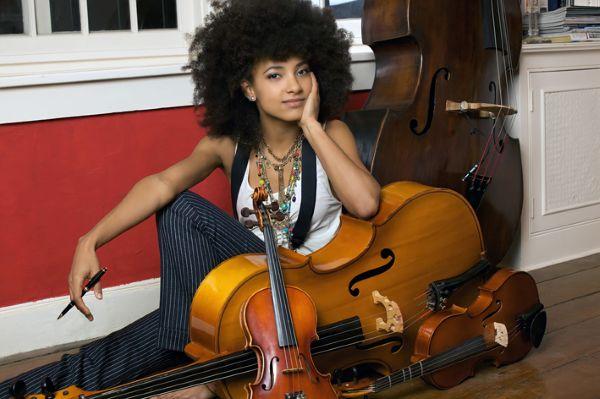
In her final interview before her retirement, KJZZ jazz host Blaise Lantana spoke with esperanza spalding who was in town for concerts at the MIM Music Theater.
Transcript/Text Alternative
Blaise Lantana: I'm talking with Esperanza Spalding, bassist, vocalist, composer, band leader, and it's wonderful to have a young woman doing all this work. How did you find your way into jazz? Let's start like at the beginning.
Esperanza Spalding: Probably with some Louis Armstrong and Ella... Well actually, I really, I really encountered it before I knew what I was encountering because there was a program in Portland, a free program for youth called the Cultural Recreation Band, and it was a music education program. And the lens through which we were getting our education was through jazz pedagogy, but I didn't know that. Um, so all the teachers were jazz musicians, like local jazz musicians, um, teaching us harmony and theory and, you know, instrument technique. It was also concert band, so it was like concert band, what they called concert band, and jazz band, um, you know, large jazz ensemble. So I didn't know that's what I was being exposed to. I think the first time I understood what I was being exposed to was jazz was on some Louis Armstrong and Ella Fitzgerald record that one of our dear neighbors who's like an auntie to me shared with me. And then, um, somewhere around my pre-teens I started to get exposed to jazz, I think Stuff Smith cause I was a violin player, I was a classical violin player, and I think that same neighbor who introduced me to Louis Armstrong and Ella Fitzgerald introduced me to Stuff Smith, she was kind of like, "You know, there's another way to play the violin." Right.
Blaise: Right.
Blaise: So you were starting on violin as a kid. That was your instrument.
Esperanza: Yeah, yeah. Well, when I was in the Cultural Recreation Band, I was playing clarinet and I wanted to study piano, but yeah, I my main instrument was violin and then when I was 14 or 15, I came upon the upright bass, and that when I was shown how it functions in the jazz ensemble, I really took a shine to it. And um then I started hearing uh, you know, Slam Stewart, and um Milt Jackson, and Coleman Hawkins, and these ones. Then I started getting really excited about this whole kind of way of playing that was new to me. And those same musicians who had been teaching me as a child had the the older kid version of the jazz program, so and I was able to participate in that.
Blaise: So what about the where the bass fits in? What excited you about that? You said it, when you found out how the bass fit into the band. What about that inspired you?
Esperanza: Yeah, I honestly I felt capable in it and I think that was just very rewarding. And I liked I liked the culture of the people that were stewards of the music and, you know, running the programs. And I liked the kids I was meeting. Like I liked the feeling of it, and I liked the sound of it, and it was very rewarding to feel like, of course, I had everything under the sun to learn, but even like knowing nothing yet, you know, I had a sense of how to do this thing and that felt really, really good. That felt really rewarding for for me. And so really it was like that sense of how to do it, the way that it fit into the band. You can you can play some basic bass and be functional and have a lot of opportunities to play with musicians who are more advanced than you. And so that was also to my advantage, like I could hold it down enough that I could keep I could get a gig and that allowed me to just have a lot of musical experience where maybe if I was trying to play alto saxophone or something, you know, it would be a lot longer until I kind of was allowed to participate in the ensemble.
Blaise: Right.
Esperanza: So that was working in my favor as well.
Blaise: Well, let's listen. Now we're going to hear Esperanza Spalding and we're going to hear her with Fred Hersch, and this is live at the Village Vanguard with Esperanza Spalding and Fred Hersch on Jazz PHX.
Song Title: "But Not for Me" [03:10 - 04:10] [Music: Intimate, playful jazz duet, acoustic piano and vocal with upright bass, medium-slow swing tempo]
Lyrics: They're writing songs of love, but not for me A lucky star's above, but not for me With love to lead the way There are more clouds of gray than any Russian play Could guarantee I was a fool to fall and get that way Heigh-ho, alas, and also lackaday Although I can't dismiss the memory of his kiss I guess it's not for me Mmm, oh me, oh my What a sad case I seem to be
Blaise: That's Fred Hersch with Esperanza Spalding live at the Village Vanguard, and I'm talking with Esperanza who has a concert coming up here in Phoenix, and you can find out more about that on our website, jazzphx.org. And so you just got started, you found your way in, you found your way into the band with the bass, which is kind of a jump from violin to bass. Physically, physically it's a big change. How did you do with that? You said that you were able to play and and get involved with uh more advanced players by being able to play the bass, but it's uh it takes a lot of strength in your hands that you might not have had on the violin. So how did you make that adjustment?
Esperanza: Um, I think that I don't know. I don't know why I could play. I could play. I had I had the strength in my hands. I don't know. I I was always kind of like a strong kid, I don't know. Not athletic, but I I kind of was like sturdy, I guess. Now I Now I'm very like uh pip-squeak energy, I don't know. I feel like I've gotten thinner as I've aged, but I was like kind of like a like a little like sturdy kid and I I had the strength in my hand, but also really early on in my studies, I had really great teachers, bass teachers who clarified that it is not a strength game, it's a technique game. And if you have good technique, you don't need this kind of brute strength thing. If you build good technique, you build the endurance slowly, you're not going to burn out your muscles. And I I had really good teachers. The thing that you have to get through is the calluses, the blisters and the calluses, and I don't know, I have a fighter spirit, so I think that kind of was like cool to me, like "Oh yeah, you know, I have these like war wounds, you know, I have these battle wounds, getting into this instrument." And honestly, the the logic of the left hand is very similar. I mean, the strings are in fourths, the violin's is in fifths, but the logic felt very similar, and it's a very logical instrument, you know what I mean? Not like trumpet, where you really have to memorize like, woah, what each each finger position means for changing the valve length, I mean the the horn length. So, I don't know, I I think that I had a lot to draw on from my music education and I was very fortunate to have, like I said, really smart, technique-oriented teachers. I started studying with a classical teacher really early on who really like helped me establish healthy technique.
Blaise: So do you think that's that I know that's pretty common actually for piano players to come in through classical music. Do you think uh it's an advantage for bass players to come in through classical music too?
Esperanza: I mean, I I don't think there's any advantage to having a quote-unquote classical music foundation. It's more just about having a music like a a technique uh um harmonic, you know, knowing how to read music can be helpful, it's not required—Art Blakey couldn't read music, uh didn't read music. Um, I think I think it's more about having the time to develop musicianship, not not to to having the time developing technical facility on an instrument. And there is about a million, maybe not a million, but there's dozens of pedagogies that you can use, you know. The sitar has its own, the gamelan has its own, you know, the the trumpet you could you could grow up playing in like a um bomba band and and develop your technique there. You know, just I think what's really helpful is at some point in your life getting acclimated to this idea that like, "Oh gosh, I can't do this today. But I'm going to practice this and then tomorrow I'm a little closer." And then, "Oh, okay, somebody's showing me the nuance of how to practice to make the development faster." I think that in and of itself is a knowledge base of what it is to come into facility. And I think having that awareness early on helps protect you from some of the exasperation and frustration that can happen when you're first learning something new. So I I think that above all else, and I mean I just had awesome teachers all throughout, but I think that above awesome, some of them were awesome. I think that above all else was like what what rooted me in my willingness to keep trying to get better.
Blaise: Were they were they surprised that a young woman would want to play the upright bass, because there weren't a lot of upright bass players, young women bass players before you. You have inspired that to happen. I see it a lot more now, but before you came along, it was pretty rare. So were they like, "Oh great, a woman," or "Oh my goodness, a woman"? What did they think about all that?
Esperanza: Well, I didn't, honestly, not many people mentioned it, not in that way. I think it was more about my stature physically than my gender. Right, I'm just, you know, I didn't have a car when I first started playing, so I would be taking public transportation. I think people just kind of be like, "Whoa, that thing is, you know, huge!" And then I didn't feel it being based on my gender. And then a couple of times people said very discouraging comments that weren't specifically gendered, but in I didn't I didn't take them as being gendered, but in hindsight I can see that they probably were. But like I said, I have this fighter attitude, and so I actually I felt I felt stimulated by that.
Blaise: Right. Oh, so you...
Esperanza: My mom is a fighter. My mom is very she um did a lot of innovative things as a woman, you know. She was a carpenter in the '80s and she was a um foreman, I forget what the word is, but you know, she she went back to community college, you know, in her 40s to study jazz guitar. You know what I mean? She she had this she has and had this like, "I do what I want to do. I do what I'm called to do" energy and I think I have that too. And only later started to really realize how gendered a lot of uh people's reactions to me were. And when someone would say something stupid and gendered or discouraging based on my gender, I had enough something or other, I don't know, I'm going to give credit to my mom, to just roll my eyes or get angry, and I think I used that anger and that frustration when it did get stirred up because of my gender to push myself, you know, which I don't endorse, I don't I don't I I I don't I wish I didn't have to go through that, AND I'm grateful that since occasionally there were really discouraging things being directed at me because of my gender, I'm glad that was my reaction.
Blaise: Yeah. Yeah, I'm talking with Esperanza Spalding. She's a bassist, a vocalist, a band leader, and let's listen to Esperanza. This is with Nicholas Payton from the album Trioun on Jazz PHX. Here's Esperanza.
Song Title: "Ultraviolet" [07:20 - 08:05] [Music: Mid-tempo, grooving modern jazz, prominent upright bass line, muted trumpet, hand percussion, and scat vocals]
Lyrics: Ooh... Ooh... Ooh... Ooh... Ooh... Ooh...
Blaise: So that's Esperanza Spalding with Nicholas Payton on the trumpet from the album Triune, and I'm talking with Esperanza about her music and how she found her way into the jazz community as a young woman. And you weren't in New York, you were in Oregon, right? That's where you started?
Esperanza: Yeah, yeah. I was there until I was 17 and then I went to Berklee.
Blaise: How was that? How was that making that...
Esperanza: ...First I got a scholarship to go to Banff, and Kenny Werner was there, I think he was like the teaching artist that year. And that was my first exposure to musicians from all over. Um, and then from Banff I went down to Boston to start my Berklee career, and I do remember actually now that we're talking about New York and gender and young and music, I auditioned for Manhattan School of Music, and in my mind that place had been very mythologized, you know, like, "Whoa, you know, all the best players were there, like go, go, go, go, go." And I I went in for my audition and they whoever was auditioning me, they just had this like chip on their shoulder, uh this kind of energy of like, "All right, show us your stuff," you know, and and like making all these snide comments about what I was doing. And even then as like a 16-year-old, I was like, "They're so stupid." I mean even then I was like, "What? This is ridiculous." I was still embarrassed and I still feel felt sad that I didn't get to show my stuff and I I got really like, you know, flustered by their uh the tone they were setting. And in hindsight, I'm sure there was all kinds of stuff going on around my color and my gender and my stature, but I I feel grateful again to my upbringing that it didn't wear on my sense of my value, you know. And that's just a privilege. Like I I know that part of the work that uh that's like a privilege of my particular upbringing and my particular tuning as a human, my personality. But that can really destroy people. That that can really be devastating, you know, if you don't understand that someone's reaction to you is about their own ego shit and not a reflection of your potential or your or your talent. That can really eviscerate people. And I feel that we need more musicians in the world, not less getting discouraged because somebody's on an ego trip. And so I I just thinking of reflecting on these stories from my own life makes me appreciate the work that Terri Lyne Carrington is doing with the Jazz and Gender Justice Institute of saying like, "Hey, we need to cultivate environments where all people of all genders are really embraced and encouraged and not expected to be compared or measured or expected to contort themselves to fit into one very gendered cultural culture or or way of administering pedagogy." And so I just, yeah, in this moment of reflection, walk down memory lane with you right now, I'm I'm uh I'm also simultaneously appreciating again the the importance of what Terri Lyne is doing.
Blaise: And are you helping your students in that same way, encouraging them and telling them, you know, don't if the band leader isn't on board, you're still good? Are you leading your students in that direction?
Esperanza: I mean, I don't have a lot of music I don't have a lot of performing music uh music performance students. I don't have a lot of music performance students right now. The students that I've been working with most closely the past few years have been in the Songwrights Apothecary Lab. Um, but yes! I it's a fine balance between taking constructive uh critique and parsing out what is just harassment. Right? You know? Or or or something else. Or or, you know, I don't know, or something else. And that is a that's a fine dance, cause there's also maybe the impulse to be like, "Oh, you know, they said I needed to work on that, but they were just trying to break me down." You know, it's like we got to learn how to parse out the precious feedback that we get, cause once you get out of school, it's really hard to get honest feedback. It's really hard to hear from people further along than you what you need to work on. So it's it's how to keep ourselves supple to feedback, or what they call coachability, and then also be sturdy enough to bat away anything that is just some bullshit. Sorry. Anything that is just some mess.
Blaise: Yeah. Right. Yeah.
Esperanza: Yeah.
Blaise: But so when you came into working with different ensembles, now you're at Berklee and you're playing with all these people, it must have been quite a change to come into that community with all of these players, again, from all over the world. And uh not all jazz necessarily at Berklee, although it's jazz-focused, it's really a variety. So how how did you fit in there and how did you make your way there?
Esperanza: I felt good. I felt I felt less intrigued by what was happening in the school and more intrigued by all these musicians that I got to record with and gig with and rehearse with, and that and local musicians, fellow students, people coming in from out of town, getting to go to New York, play a thing or two there, you know, um...
Blaise: Now and you also started singing. Did that happen at Berklee? Was that where that started?
Esperanza: No, I started singing in Portland to join a band a rock band, kind of like this pop rock kind of alternative rock pop band. Um, that they lost they lost their bass player because their bass player moved to New York, and he would sing in the band. Sorry. And when they when I got the word that this band was looking for bassists, they were like, "Oh, but the the bassist has to sing." And I just said, "Yeah, okay, cool, I can sing." And I had never I had never sung. And I I learned the songs, I figured out, I made the audition, they were like, "Yeah, you got the gig." And then that was the place that I really started developing um my singing. And I used to shed—no, I should I I should say that differently. A a wonderful piano player called Dan Gaynor in Portland, Oregon befriended me and uh was one of those people of the of the spirit that was very prominent amongst the the educators in my town: "If you care about this music, you're entitled to learn about it. If you care about it, I will teach you about it." And so I used to go to his house or his dad's house and we would just play tunes, and I didn't understand what the symbols meant yet, so I could read the bass note and I would sing the melody, and that counterpoint would help me understand the harmonic progression. So that's also between learning and shedding with Dan Gaynor and this pop band, that's how I uh came into being able to sing and play.
Blaise: Quite...
Esperanza: And then I of course started developing that.
Blaise: Your unique style that you, and that unique style that you have for singing. And so let's listen to some of that. I want to listen to Radio Music Society. Here's Esperanza Spalding, and you get to hear her sing and play the bass on this album. This is from 2012, her album from 2012, Radio Music Society. Here's Esperanza Spalding.
Song Title: "I Can't Help It" [11:30 - 12:25] [Music: Medium-fast tempo, vibrant R&B/jazz fusion with buoyant upright bassline, brass riffs, and soulful, melodic vocals]
Lyrics: Oooh, yeah... Ooh, yeah... Ooh, yeah... Get in the light I can't help myself Was looking in my mirror Took me by surprise I can't help but see...
Blaise: That's Esperanza Spalding from her album Radio Music Society on Jazz PHX. And if you want to find out more about her upcoming concert, you can check our website, jazzphx.org. So now today we've been talking about how you got started and where how you got into Berklee and now you teach there, you teach at Berklee, is that correct?
Esperanza: Oh no, I I only taught there for a few years from I want to say '05 to '07, or maybe maybe I have to check. I think I only taught there for two years. And then I I spent I did plenty of master classes here and there, and then I taught at Harvard for five years, and then um I'm teaching I've taught a last year and this year I'm teaching a six-week course, co-teaching this year with Marisol Norris, uh the Songwriters Apothecary Lab, and the Harvard is where I first started offering Songwriters Apothecary Lab as a course as well, even though it's also like a living arts practice. Uh...
Blaise: So what is that? What is...
Esperanza: Oh, the Songwriters Apothecary Lab is a project that it's a lab that invites musicians curious about the therapeutic potential of of song, of performance, of composition, and people in health science in health sciences, in arts-based therapeutic practices, who are holding a lot of the practical knowledge and um the research, like the studies, information about, you know, what has been shown so far, at least in clinical contexts, um to have health benefit. Uh...
Blaise: So are so are you talking about people listening to the music or the therapeutic benefit of playing the music?
Esperanza: We're talking about what is the method for collaboratively creating music to tend to a specific ailment.
Blaise: Oh, wow.
Esperanza: Um, so it depends on the context. Maybe the group or the individual or the individuals you want to serve would be best supported for whatever you want to support them with by going through the process of music music making themselves. So then it's a question of how do you come into skill um an ability to facilitate that music making process to have therapeutic benefit. And it's as much as musicians do know about the healing power of music, we don't know everything, and we have a lot to learn from health practitioners about how one goes about A) researching, constructing, administering, creating consent, create, you know, there's so many inviting consent, creating shared agreement around the outcomes and the practices and evaluation. So it's really a space for um musicians who want to uh develop more of a practice of offering music for therapeutic benefit, again whether that's performing it, writing it, supporting others in the creation of it, um and also for the people in health sciences, in the research field, in neuroscience, in psychology, psychiatry, arts therapy, to find ways to deliver the knowledge that they're holding. Cause you could you could know a gazillion things about how sound affects our brain, but if you don't have a vehicle to deliver the therapeutic benefit, whether that's a song or a soundscape or whatever, kind of doesn't help the people that the research is intended to support, we pro- we suppose. So that's what the lab is. It's a it's a it's a space where we can really be in that practice together and go through the cycle of identifying the research question, identifying who we want to offer the music for, identifying the elements that would need to be brought in, the administering methods, and then the evaluation methods that are most um appropriate for the context. So that's that's at work and like I said, like I mentioned, I've been collaborating closely with uh Marisol Norris um on this and also Ghanavya Doraiswami for many years. So they are my collaborators it uh and and I want to say mentors and co-conspirators in this work.
Blaise: And how did you make that shift from just being a musician, composer, to this lab?
Esperanza: Yeah, I mean I started learning about different ways that music had been used as a therapeutic technology maybe like in the 2010s, somewhere in there, 2010, somewhere. And then I when I started encountering those histories, I realized like, "Whoa." I mean that we know that music makes us feel better, obviously, like, but I guess it like it made me more conscious of, "Whoa, what am I what am I doing if I'm not aware of the impact that these sounds are having on the listener or even on myself?" Right. And so with 12 Little Spells, that was the first like exploration of, okay, what would I study? Like what would I look to? How would I how would I start crafting songs to offer something really specific? Um, and then during that project, I realized like, "Oh, actually this would make more sense or maybe I could deepen this inquiry by collaborating with people who really are in this study, like their whole life is about this kind of study—the researchers, the arts therapists, the psychiatrists, like, you know, I'm psychologists, etc." So I I I wanted to be in a more held study and practice. And I also, yeah, so that's that's pretty much how it evolved. And I'm so sorry to cut it short, but I'm going to have to go.
Blaise: Oh! Thank you. Thank you so much.
Esperanza: It's my time to stop.
Blaise: It's great to talk with you and to hear your ideas. Thank you so much. I've been talking with Esperanza Spalding today, and we're going to hear some more of your music. Thank you.
Esperanza: Thank you. It was good to meet you, and I'll see you soon.
Blaise: Good to meet you. I'll see you in the fall.
Song Title: "A Day in the Life" [16:45 - 17:40] [Music: Slow tempo, evocative folk-jazz arrangement with fingerpicked acoustic guitar, bowed double bass, and gentle vocal duet]
Lyrics: Ah... I read the news today, oh boy About a lucky man who made the grade And though the news was rather sad Well, I just had to laugh I saw the photograph He blew his mind out in a car He didn't notice that the lights had changed A crowd of people stood and stared They'd seen his face before Nobody was really sure if he was from the House of Lords I saw a film today, oh boy...