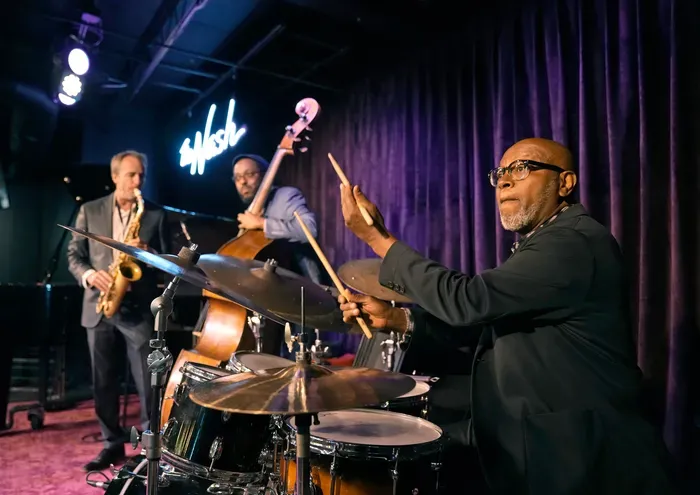
PHOENIX, AZ — The Nash is proud to announce the debut of its premier house band, The Nash Collective, a dynamic new ensemble created to represent the venue on both the national and international stage. Designed as both a performance powerhouse and an educational force, The Nash Collective brings together an exceptional lineup of musicians from across the national jazz scene.
For its inaugural performance and live recording, the ensemble featured nationally recognized artists including Hammond B3 organist Pat Bianchi, guitarist Paul Bollenback, trumpeter Ashlin Parker, Brice Winston on tenor saxophone, and acclaimed drummer Lewis Nash, performing original compositions by the Nash Collective’s musical director, saxophonist Clark Gibson. This ambitious initiative is made possible through the generous support of donors Stu Siefer and Dr. Radbeh Torabi, whose three-year commitment will fund the ensemble’s performances and annual live recordings.
The Nash Collective plans to perform twice each year at The Nash and release a new album annually, featuring original compositions by Dr. Gibson and other members of the group. “I’m so excited to be a part of a world-class ensemble that will represent The Nash nationally and internationally,” said Gibson.
More information at thenash.org.
An Interview with Clark Gibson and Lewis Nash,
Hosted by Blaise Lantana
[00:00 - 00:22] [“Counterclock” - Music: Bright and rhythmic contemporary jazz with a swelling alto saxophone lead, rich acoustic piano chords, and brisk, driving drums at a medium-fast tempo]
Blaise Lantana: That is Clark Gibson's band doing counter clock on jazz PHX. I'm Blaise Lantana, I have some special guests with me here in the studio to tell us about a brand new project that's happening here in Phoenix. Clark Gibson is here and Lewis Nash is here, and we're going to talk about the Nash Collective. Welcome, guys.
Clark Gibson: Nice to be here.
Lewis Nash: Nice to be here.
Blaise: So tell us about your Nash Collective, what is this? Now we just heard Clark Gibson, he plays sax and he is the director of education at the Nash, is that your title?
Clark: Yes, that's correct.
Blaise: And so, you're making sure that the next generation is finding out about jazz.
Clark: Yeah, we're working, we're working on it for sure. We have a lot of big education programs there including a summer camp that's coming up this coming week.
Blaise: Oh. So, is... now do kids come from high school or middle school or...
Clark: They come from all over the state, yeah. High school, middle school, and then we actually have adults at the camp too, as well.
Blaise: And if they want to come, is it free or do they pay? How does it work?
Clark: Uh, it's... there's a tuition, and then... but about 40% of our students are on scholarship, meaning they attend for free. Yeah, so.
Blaise: Very good. And are they learning... I mean what are you doing? You got them in a big band and...
Clark: Sure. Yeah, I'm glad we're talking about it, uh, because a lot of the members of the Nash Collective teach at the summer camp and, so, we have about 130 students coming to Arizona School for the Arts. And we have 18 different faculty members coming from all over the country which includes many of the members of this band, like Ashlin Parker on trumpet, Pat Bianchi, of course Lewis is on drums, we also have Corcoran Holt, as well as Rodney Whitaker, Camille Thurman, who's coming from Montreal, so, it's a, it's a really great experience. But...
Blaise: I'm talking today with Clark Gibson and Lewis Nash and he's talking about the education program at the Nash, if you're interested in that what can, how do you find out more?
Clark: Uh, just go to thenash.org/education and there's a, there's a link there to the summer camp. It'll tell you all about it.
Blaise: Are you all filled now, or can people still get in?
Clark: We're filled, actually. Yeah, we... the registration deadline was, uh, was Monday evening.
Blaise: Woo! Yeah, set to go. Well, some of the people you were saying are teaching are going to be part of the Nash Collective. So what is the Nash Collective and how did you guys come up with this idea? What...
Clark: Yeah, so the Nash Collective is... it's a new ensemble that, uh, is... its goal is to represent the Nash nationally and internationally through touring and recording, um, doing education across the country. So, it's, uh, similar to what SF Collective is doing out there and Lincoln Center in New York, so, it's, uh, it's time that, that we had that here in Phoenix.
Blaise: Right, right.
Blaise: And we... since we have you, Lewis, this is like a, a great draw for people, I think, just to know you're here. You've played with so many different artists. I mean we were talking about getting to play with Sonny Rollins and... do you remember some of your, your favorites, big names that you've worked with?
Lewis: Yeah, you know... of course Sonny, Oscar Peterson, of course Clark Terry, people like that, so, what, when these younger musicians come along that, that we're, um, seeing at the camp and at the, the year-long also, there's stuff going on year-round, but we're able to through our own experiences with these giants kind of pass on information directly to them that we've got.
Blaise: So, right, what was it like playing with Oscar Peterson? I, the reason I ask that is there is so much to what he does, I'm wondering how you find your space in there.
Lewis: Well, he, he was a... such a well-rounded musician. I mean we're, we're impacted by his, uh, virtuosity and velocity and all that, but he was one of the great ballad players and he knew how to, uh, be a rhythm section member without overtaking the rhythm section. So I think we're, we're used to hearing, you know, all of this, the impact of all that he does, but he was, uh, in, in honest, in all honesty, a very well-rounded rhythm section player.
Blaise: So, you, you were pretty young when you worked with him, I'm guessing. And so, was he directing you? Did he give you ideas?
Lewis: No, the funny thing is, uh, people like Oscar Peterson and, well, at least at the time I worked with him, I can't talk about what he was like years and years ago before I was on the scene, but by the time I started working with him and also Sonny, I can say the same thing about Sonny Rollins, they chose us sidemen kind of based on what they heard us doing and they didn't give too much direction when we were rehearsing or performing, they just allowed us to find our way without too much verbal, you know, direction, at least those two. Now some people were more verbal with what they wanted.
Blaise: Yeah, more telling you exactly what they wanted.
Lewis: Yeah, that John Lewis was more like that, Ron Carter was more like that, but and Tommy Flanagan would who I also worked with for 10 years was more like Sonny, not a whole lot of do this, do that, but, um, you know, you, you know that you're there because they want you there, so.
Blaise: That's pretty impressive. Did it make you play differently? So, you're playing with, so, talk about you're playing with, with Oscar Peterson, you're playing with Tommy Flanagan. Two different cats, two different styles. How does that affect what you're doing on the drums? Like...
Lewis: The way I look at it is there's a, there's a, uh, continuum of of what I'm supposed to do no matter who I'm playing with and so that is always there, but then whoever it may be, then my ears are always open to the uniqueness of that individual, and then I, I kind of shape my, the the way I would play with anyone starts to take on the kind of the character, uh, of the person I'm actually playing with. So I think that as a drummer I have a certain role, no matter whether it's a big band, a small group, whoever the the members of the group are, um, I have a certain thing that I'm supposed to do to help the music come alive, right, but then each person's, uh, musical identity and, and, and, uh, character is different, so, those adjustments I make on the fly, so to speak.
Blaise: I'm talking with Lewis Nash, who is a part of the Nash Collective, and Clark Gibson, saxophonist and educator, Lewis Nash, a drummer and educator, of course, both composers and all of that, they're here with me today, and, uh, Lewis is teaching at ASU, right?
Lewis: That's correct, yeah.
Blaise: So, are you teaching drums or are you teaching ensemble, what is it...
Lewis: Both, I teach private drum set lessons, I, um, I coach, uh, ensembles, small groups, uh, combos, and then I also teach a class which is called repertoire, and, uh, we delve into the, the jazz standard repertoire, the Great American Songbook, and also, uh, compositions of jazz musicians played through the years. And we examine why jazz players like to play certain tunes, we hear various versions of them, etc.
Blaise: Ah, that's fascinating. Isn't that, yeah... Yeah, how come everybody picks this tune? Is it because the teacher in the class does it or... but there are certain tunes that, yeah, that are high up on the request list of jazz musicians and, yeah. All right, let's listen to the Nash Collective, which we haven't done yet. Here they are with a tune called Dem Over There. You want to mention, talk about this tune, Clark?
Clark: Sure. Um, yeah, it's just kind of a fun little, kind of starts with a 6-8, I guess, what would we call this groove, Lewis? We'll call it like a, like I call it the Ko Nama groove.
Lewis: Yeah, yeah, yeah.
Clark: Um, and then it goes into a nice, nice hard shuffle after that, but it features everyone in the band, it's a fun tune.
Blaise: So who's on this?
Clark: This is, um, Brice Winston on tenor saxophone, Ashlin Parker on trumpet, Pat Bianchi on the organ, Paul Bollenback on guitar, and of course, Lewis Nash on drums, and myself on this take on baritone saxophone.
Blaise: All right, baritone sax, all right, let's listen to the Nash Collective on jazz PHX.
[11:34 - 12:12] [“Dem Over There” - Music: Lively 6/8 Afro-Cuban jazz groove shifting into a hard-swinging shuffle, featuring rich Hammond B3 organ swells, warm guitar lines, and a deep, mellow baritone saxophone melody at a medium-up tempo]
Blaise: That is the Nash Collective on jazz PHX, or if you're listening on the radio, KJZZ 91.5 HD2 Phoenix. This is Clark Gibson, saxophonist and educator, Lewis Nash, a drummer and educator, of course, both composers and all of that, they're here with me today, talking about the music and what they've put together here, a band called the Nash Collective, which is a movable feast, right? It's going to be...
Clark: Right, yeah, I mean for example, at the MIM, it's still the Nash Collective, but it's a collection of musicians that Lewis and I talk about and put together to, to represent the Nash, so.
Blaise: Right, so, uh, at the MIM, you're going to have Camille Thurman instead of Brice Winston, Camille's a saxophonist and, uh, singer as well. But you said you played Barry sax on that last tune, right?
Clark: Yes, that's correct.
Blaise: So, tell us about moving around from one saxophone to another.
Clark: Well, the Barry is just like a big alto, right? It's just... it's just bigger, you know, and so, and you can kind of get away with, with more. Alto, if you play something bad, everybody knows it right away. Barry, they're like, well, that's cool.
Blaise: But it is quite a different sound, and when you're... I mean, it carries differently. So, if you play one note on the alto, the, the... it's quicker for that sound to disappear, whereas on the Barry, it really does, because of the lowness of the, we were talking a little bit about the lowness of the note, it really carries. How do you create the different style you're playing with? Do you have an idea in your head, or do you really just think of it as that big alto?
Clark: Yeah, I think of it as the big alto, but, you know, it's, I mean obviously there's certain tunes that lend towards that sound better, like, and I feel like the tune that we just played...
Blaise: Dem Over There, with the Nash Collective.
Clark: Yeah, really kind of, Barry really kind of fills up the low end of it, and it just, you know, it gives it a, a certain, a certain vibe that you wouldn't get on the alto.
Blaise: Mhm. So, normally what do you play? Do you have a primary instrument?
Clark: Alto is what I play most of the time. Yeah.
Blaise: That's unusual. Charlie Parker...
Clark: Yeah. Yeah, I think Charlie Parker scared a lot of people away from the alto.
Blaise: Yeah, and, and now, well, a lot of players evolve into the tenor, the tenor saxophone, which is, uh, if you, I mean I don't know if our listeners know every little detail about this, but think about a choir, you have a tenor, you have an alto, and it kind of resonates in a similar range as the singers do, but the tenor sax is bigger, it's heavier, and the baritone sax is even bigger and heavier, and when you're playing an alto, it's brighter, it's a much brighter sound, but often people evolve to the tenor saxophone. Do you know why that is?
Clark: I think the tenor's in, it's in a vocal range of human beings, you know, that's, it's there and it's, you know, some people, I don't know if this is true, some people say tenor's easier, I don't think it's easier, as, and if it is easier, it doesn't matter because there's, as a good friend of mine, Michael Dease, told me once, there's too many pictures on the wall. There's a lot of famous tenor saxophone players. So, if you, if you want to play tenor and be great, you better be super bad because there's a lot of them.
Blaise: Right, right. You have to follow in the footsteps of Coltrane and Sonny Rollins and all that. So, but...
Clark: Yeah, I think you're right...
Blaise: So, who do you like to listen to on the alto? Who inspires you?
Clark: Of course, Charlie Parker is my biggest hero, but then Cannonball Adderley, Sonny Stitt, who played both horns equally well, but I love his alto playing, Phil Woods, um, Jackie McLean, I've been listening to a lot of him lately, he's, um, so, yeah.
Blaise: Are you listening to Jackie...
Clark: Charles McPherson, who's coming to the Nash, actually, in the fall, going to be playing with Lewis.
Blaise: He's got an alb... a new album out with, uh, trumpet player and Samara Joy, they wrote some music for it, we have a brand new one with, uh, Charles McPherson on it, but how, how do you get a good tone out of the alto? Is, is it harder or...
Clark: Alto's pretty tough to get a good sound on, it takes years of development, I feel like, and McPherson's a perfect example of just of an amazing sound on the saxophone. He was actually one of the first alto players I heard when I was a kid. Um, and, but, you, lots of long tones, lots of listening, lots of playing with people.
Blaise: Is it air? Is it, um, how you use the air or...
Clark: It's more like a singer, it's like a, it's like what happens inside of your oral cavity and in your throat, and in your throat, because the horn is, is an extension of you, really the sound starts with you, you know, and so it, Charlie Parker said every muscle from your belly button up, you know, is, is playing, creates the sound, you know, so it's, it's, it's really just an extension of you, you know, and it's interesting because I'll try to imitate, I'll try to imitate people, I don't anymore, but I spent years trying to imitate Cannonball and stuff like that because he has such a beautiful sound, but then you look at Cannonball, Cannonball's got this big head and this big oral cavity, there's no way I can imitate that. He's a different physical person. And different emotional person.
Blaise: All right, well, let's, yeah, let's listen to it. Here is Eli, done by the Nash Collective. Clark Gibson, what, what saxophone are you playing on this one?
Clark: Alto on this one.
Blaise: Alto on this, Lewis Nash is at the drums, and this is Eli on jazz PHX.
[24:18 - 25:02] [“Eli” - Music: Soulful, lyric-like slow jazz ballad with an expressive, warm alto saxophone lead, cushioned by soft Hammond B3 organ chords and gentle brushed drum beats at a relaxed, slow tempo]
Blaise: That is the Nash Collective doing a tune called Eli by Clark Gibson, and he's here with me in the studio along with Lewis Nash. Now, Lewis, you were a good friend of Herb Eli.
Lewis: Indeed.
Blaise: And how did you get to know him?
Lewis: Well, I met Herb, I think, the first time probably at the Paradise Valley Jazz Party that Don Miller used to put on.
Blaise: Oh, yeah, that was fun.
Lewis: Yeah, and so that was probably my first introduction to him, but then over the years we've would see each other at these events, such as that, and on the jazz cruise. Uh, so I got to know he and his wife, Lorene.
Blaise: And did he come up with the idea of naming the club after you?
Lewis: He approached me, uh, he's the first person to approach me and talk to me about the fact that they were creating this institution and that they wanted to name it in my honor, since I'm a, uh, Phoenician who went out into the world and...
Blaise: Did good.
Lewis: ...hometown, uh, kid makes, does well, does good. So, um, he's the first person to approach me, uh, he and Joel Goldenthal at the beginning were coming up with these ideas. So Herb is the person who asked me if I was okay with that, and of course I, I was, and the rest is history. And so...
Blaise: Was your family excited? Your family is here... I've seen them at some of the events, yeah.
Lewis: Yes, yes, my parents are, they're no longer here, but they were here in those days, you know, and so, uh, they had a chance to come out to, uh, the Nash on several occasions, even my grandmother who had, who hadn't really heard me play that much at that time, she was 90-something when she heard me for the first time in a live performance. So, and so Herb and Lorene were there for that, um, many occasions. So, Herb is very instrumental in, as Clark was saying, in the, uh, maintenance and sustaining of the Nash during, particularly during COVID and, and, and, and, such, but a real friend of the music and a friend of musicians.
Blaise: Yeah, yeah, and always... and often showed up, just showed up. You know, sometimes I want to say that to our listeners, sometimes you, you might not have a lot of money, but if you can show up, that's something, you know, if you can go to a concert or go to a gig and hear musicians play live, that really keeps their energy and their force going. And so, it's a wonderful thing that you can do, not only for yourself, which of course is great to go and hear music, but also for the whole jazz scene, is just go out and hear music. Now, we're going to listen to a tune you did here called the Highest Mountain. What can you tell me about this one?
Lewis: That one was written by a tenor saxophonist I worked with some years ago, the great Clifford Jordan. And I worked at the time, I worked with the Clifford Jordan-Art Farmer Quintet. And, uh, those of you who are, who don't know, Art Farmer has a connection with Phoenix. He and his twin brother, Addison, uh, for a time went to school here at, uh, what became Carver High. Art used to tell me that it, when he was going there, it was called Phoenix Union Colored High School. So you're going back a ways to the, must have been in the, early '40s, maybe, must have been, yeah, in the '40s, when he would have been in high school, early '40s probably, I'm guessing. So, uh, yeah, so he, anyway, I, playing with Clifford Jordan often and listening to his sound and his, and I listened to a lot of his recordings and I fell in love with that particular tune and I always wanted to record it. So when I had the opportunity to do so, I did.
Blaise: Now, is this your band with Jeremy Pelt, trumpet, Jimmy Greene on sax, Renee Rosnes piano, who's on the, and Peter Washington?
Lewis: Peter Washington, yeah, that was my quintet.
Blaise: And so, these, these are the people that you worked with on your album, right?
Lewis: That's correct.
Blaise: Now, you're going to be working with the Nash Collective, you think you might bring them in at some point?
Lewis: It's possible. It's possible to do all of what... Clark and I are just, we're open to many different possibilities with this situation.
Blaise: Cool. Yeah.
Blaise: So, you're creating this thing called the Nash Collective, and that means that the two of you will be in the mix and then you will pull in different people that you know, or that you like, or that serve the songs that you choose, right? So, how did you pick the people that you have going on this album that's going to be coming out in the spring of '27? How did you, how did you pick them?
Clark: Well, we kind of had a history of working together a lot and we had a history of, of music and a band together already and a sound, so it was kind of ready to go as, as a project, you know, kind kind of since we'd already worked with Pat Bianchi quite a bit before and we've worked with Brice, and, and Ashlin's been around a lot over the last couple years.
Blaise: And you have... Paul Bollenback on guitar?
Clark: Yes, yeah.
Blaise: Is Corcoran Holt playing?
Clark: No, it's, uh, B3 organ. So, yeah, Pat's playing, he's doing double duty.
Blaise: Putting the bass player out of work, yep.
Lewis: Well, Corcoran's definitely going to be a part of upcoming...
Clark: Absolutely.
Blaise: Because we have such good, we have so much talent here in the Valley and it's growing all the time, it's really exciting, you know, when I tell people we really have an amazing jazz community and people who go out and do all kinds of different things, you know, it's just a wonderful opportunity to hear music. Well, let's listen now to Lewis Nash and his band, Renee Rosnes is at the piano, and Jeremy Pelt is playing some trumpet, Jimmy Greene, sax, Peter Washington playing that bass, and Lewis Nash at the drums, here they are doing the Highest Mountain on jazz PHX.
[36:05 - 36:50] [“The Highest Mountain” - Music: Energetic hard-bop jazz with a blazing trumpet line, cascading acoustic piano runs, and a driving, fast-tempo swing rhythm held together by a tight double bass and crisp, dynamic drum fills]
Blaise: All right, Lewis Nash playing those drums on the Highest Mountain with Jeremy Pelt, trumpet, Jimmy Greene, sax, Peter Washington playing that bass, Renee Rosnes at the piano, and Clark Gibson, who are putting together a brand new project, a band called the Nash Collective, which, as we said, is a movable feast. They are just mixing it down and producing it and it's going to be out in the spring of... 2027, I do know what year it is.
Clark: Yeah, the plan, yeah, we'll get it released first, and, uh, take the band out and represent the Nash nationally.
Blaise: Very, very exciting to have that, that happening, to have our name, you know, traveling around the world with this wonderful music that you're doing. And when you put this project together, was that your plan, to be able to expand this?
Lewis: Yes.
Blaise: Why?
Lewis: Because I believe that it keeps things fresh, it keeps us, uh, musically, uh, involved in different sounds and different possibilities, and I, I just really like that.
Blaise: Well, I, yeah, and I would think since you have played with so many different people, you don't get as much of an opportunity as maybe you had 20 years ago, and so you're putting that opportunity back on the table, right? Only this time, it's your game. You're calling, you're pulling in the...
Lewis: And able to bring people here and, uh, take advantage of that connection established, you know, over the years.
Blaise: Right, people who just love playing with Lewis Nash, they'll be like, yes, I'll come out there, can we do it in January? Can we do it in February, please don't make me come in July. All right. And tell us about this tune, Clark, that you wrote, look at you.
Clark: Yeah, look at you. Uh, so I had written this tune just a few days before the recording session, actually, and, uh, I had just finished the tune, I went to a local coffee shop that I really like and, and I was, I had some other business going on that day so I was wearing my suit, you know, I was looking kind of good as good as I can look at my age. And, uh, one of my friends who works at the coffee shop looked at me and goes, "Look at you," and I thought, I hadn't named the tune yet and I thought, that's a perfect tune name, you know, you can use it that way or, you know, if someone's acting foolish or something, you can be like, "Look at you." There are a lot of different, and it's, you know, kind of a catchy, catchy tune name as a catchy tune, and, yeah.
Blaise: It's exciting, it's an exciting time, and thanks for coming by, guys.
Clark: My Pleasure.
Lewis: Thanks for having us.
Blaise: Here is the Nash Collective.
[45:10 - 45:45] [“Lukachu” - Music: Playful, bluesy post-bop jazz featuring a swinging alto saxophone solo, groovy Hammond B3 organ comping, and rhythmic acoustic drums in a steady medium tempo]