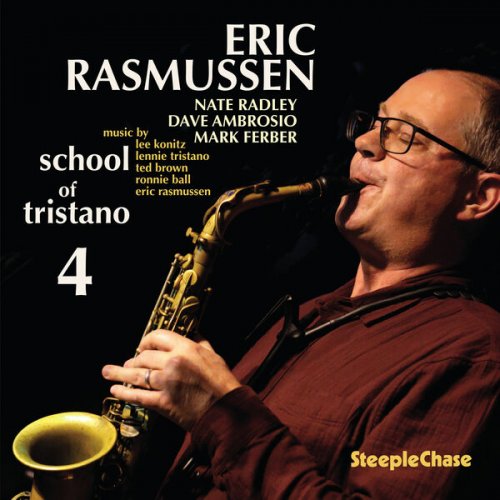
ERIC RASMUSSEN – SCHOOL OF TRISTANO VOL. 4
Eric Rasmussen - Alto Saxophone
Nate Radley - Guitar
Dave Ambrosio - Bass
Mark Ferber - Drums
Twenty years after their acclaimed trilogy, Eric Rasmussen and his long-standing quartet return with School of Tristano 4-a revelatory deep dive into the compositions and aesthetics of Lennie Tristano, Lee Konitz, and Warne Marsh, paired with striking originals. Drawing from decades of study, stage experience, and personal connection, Rasmussen's quartet reinvents this rich, often-underrepresented repertoire with stunning clarity, warmth, and spontaneity. While the album brims with telepathic interplay and ensemble finesse, Rasmussen's alto saxophone sings with a personal voice, never imitative, always rooted in the language of deep jazz tradition but reaching forward. Guitarist Nate Radley, bassist Dave Ambrosio, and drummer Mark Ferber bring unmatched sensitivity, groove, and lyrical depth. School of Tristano 4 offers both serious jazz heads and adventurous listeners a fresh insight into classic modernist repertoire-an album that resonates with the spirit of Tristano while speaking entirely in the quartet's own voice.
Liner Notes
The first bebop recordings of 1945 sounded revolutionary to many listeners used to small-group swing. Fast, intricate lines outlining the changes with freer use of dissonant chord extensions, strange rhythmic displacements, and abrupt juxtapositions made the music shockingly new. But even as Charlie Parker’s and Dizzy Gillespie’s bebop was reaching its audience, other modernists were creating equally surprising new music in related, adjacent scenes. Thelonious Monk had been working in his own direction, both part of and somewhat apart from bebop’s beginnings. Lennie Tristano (1919-78) was equally independent. Tristano’s approach had a lot in common with Parker’s and Gillespie’s music, including wildly inventive melodies composed over favorite chord progressions from existing popular songs, but the even more densely chromatic language, cooler tone, and understated ensemble dynamics were different. Tristano was at the center of a small scene including his students, saxophonists Lee Konitz and Warne Marsh, who extended his ideas. Some of their now-famous tunes began as homework assignments.
Over the decades, as bebop has become a common language among jazz musicians, the Tristano school’s music (like Monk’s, Herbie Nichols’, and a few others’) retains its freshness and is revisited by musicians searching for something challenging and new. Eric Rasmussen and his quartet, in their previous three School of Tristano recordings and live gigs, are among the best. They’ve made this music their own over two decades, integrating careful study of the compositions with newer ideas about how to improvise and interact. Interaction is one of the big diff erences: Tristano once said he needed “the feeling of a constantly flowing pulse no matter what happens” and derided drummers’ interactive fi gures — defi ning features of bebop and modern jazz (although Lee Konitz later worked with all kinds of accompanists, including the very interactive Elvin Jones). Eric Rasmussen’s quartet is all about four-way interaction, dialogue, and mutual support, and they improvise on this music in their own ways, informed by a thorough knowledge of jazz history, including the last fi fty years of jazz innovations. The result is a fresh and exciting new take on this classic but still somewhat underground repertoire.
Eric discovered Lennie Tristano’s music when he was already a working musician in New York. “I heard it and said ‘Where has this been all my life? This is something I’m very interested in. The aesthetic -- this is what I like to do as an improviser and 2 as a sideman and also performs with the collective ensemble Running From Bears and the Eric Rasmussen Quartet, both of which have toured the United States on numerous occasions. Eric is the Director of Instrumental Music at Scottsdale Community College, where he has taught for the last 14 years.
Eric Rasmussen: Eric Rasmussen is a saxophonist/composer who relocated to the Phoenix area in the summer of 2007 from New York City. Originally from California, he spent the previous ten years playing in New York City where he was a staple of the jazz community, performing regularly on the East Coast as well as multiple tours of Europe. While in New York, Eric performed frequently with some of the most respected names in jazz including Lee Konitz, Joe Lovano, Donny McCaslin, Billy Hart, and Matt Wilson among many others. In Phoenix, he is in top demand 6 Allan Chase, March 2025 saxophonist, composer, researcher, and professor of Jazz Composition at Berklee College of Music. composer myself.’ So I just got into checking out the music and transcribing some of the solos.” He had been somewhat aware of Lee Konitz, by far the best-known artist from the Tristano circle, in college, but the innovative early recordings with Tristano and Marsh were more elusive. (One of Eric’s teachers at CalArts, guitarist Larry Koonse, played with Warne Marsh on some of his last gigs, but they didn’t discuss this until they played some of this music together later.) In 2000, Eric toured Europe with Swiss trombonist Christophe Schweizer along with a band led by Ohad Talmor that included Lee Konitz. When Eric moved to Phoenix, Arizona in 2007, he was able to invite Lee Konitz as a guest artist and teacher twice, fi rst in 2010 with the all-city high school band Eric directed, Young Sounds of Arizona, and in 2015 at Scottsdale Community College, where Eric leads the jazz program. These experiences gave him a chance to get to know Konitz off -stage and to hear him up close in a variety of settings, adding many visceral experiences of Konitz in action to the perspective gained from close study of recordings.
One thing we can learn from Lee Konitz is that imitation is clearly not the goal; the more one was exposed to him, the more one learned that jazz improvisation is about playing spontaneously from your own inner hearing and creative imagination in the moment, not about copying an idol’s mannerisms. Eric Rasmussen and his quartet demonstrate the wisdom of that creative approach throughout their work here: they play the tunes masterfully, and they make the expression and improvisation new and personal each time. The quartet heard here have been a band of friends for twenty years.
When they came together in Arizona for a series of gigs and this recording, they hadn’t played as a quartet since the time of the three earlier SteepleChase School of Tristano volumes, 2006-8. (Those featured another friend, Matt Wilson, on drums, but Mark Ferber was their regular drummer on New York gigs at the time.) They stayed together at Eric’s home near Phoenix, reconnected, rehearsed, performed, and recorded in the beautiful state-of-the-art musician-owned Ravenscroft Studio. The warmth and familiarity, trust and spontaneity of old friends reuniting and creating together are palpable throughout this recording. So is the growth of each musician; while the earlier volumes more than hold up after nearly twenty years, there is a maturity and clarity of expression that comes with the daily musical and personal growth and experience that all four have gained over those years.
Dave Ambrosio: David Ambrosio is one of New York City’s fi nest freelance musicians and educators for the past 20 years. He is the co-leader of two collaborative bands, Grupo Los Santos and 40Twenty, as well as being a part of many groups including George Schuller’s Circle Wide, the Matt Renzi Trio, Eri Yamamoto Trio and the BMI/New York Jazz Orchestra led by Jim McNeely. He has also performed with such jazz greats as pianist Kenny Werner, Terry Gibbs, Buddy DeFranco, George Garzone, Joseph Jarmon and Ralph Alessi. David recently released his second recording as leader entitled “MOMENTS IN TIME“ on the SteepleChase Label.
Nate Radley: Nate Radley is a guitarist and composer who leads his own group, can be heard with a variety of collaborative projects, and works as a sideman in numerous bands both in the New York area and around the world. Nate’s most recent release is “Puzzle People” on SteepleChase Records (2021) and features a trio setting with Adam Nussbaum on drums, and Jay Anderson on bass. The album includes originals and covers of pieces by Roger Miller, Isham Jones, and Victor Young. Nate is currently an Associate Professor in the guitar department at Berklee College of Music. In addition Nate has taught clinics at high schools and universities throughout the United States.
Mark Ferber: Drummer Mark Ferber can be heard on over 200 recordings. Ongoing projects include ECM recording artist Ralph Alessi’s ‘This Against That’, the Marc Copland Quartet, the Brad Shepik Organ Trio, and his twin brother, Alan Ferber’s Grammy nominated big band and nonet. He currently maintains a busy freelance schedule throughout Los Angeles’ and New York’s jazz clubs, recording studios, and international touring circuit. Past work includes tours and recordings with Lee Konitz, Gary Peacock, Jonathan Kreisberg, John O’Gallagher, Don Byron, Fred Hersch, Tony Malaby, Anna Webber, Mark Helias, Pete McCann, Matt Pavolka, Michael Attias and Billy Childs, among others.
About The Music
Ted Brown’s line Jazz of Two Cities is based on the 1932 song “Play, Fiddle, Play” – like Lee Konitz’s “Kary’s Trance” heard on the first School of Tristano disc. The nearly telepathic spontaneous interaction of the two alternating duos here, alto-drums and guitarbass, and the seamless hand-off s and perfect time as they exchange choruses are early indications of the least-known of the several Tristano-school pieces using the changes of “Pennies from Heaven” in minor (an example of Tristano’s dry humor?). The band interprets this in their own way, as a bluesy, loose 12/8 shuffl e. Mark Ferber plays a melodic drum solo over lush guitar and bass harmony.
Student Loans is a bright, up-tempo Rasmussen original based on the chord progression of “Milestones,” the bebop tune written by John Lewis and given to Miles Davis. As the composer is an alumnus of two expensive schools and the father of a college student, the title alludes to a common and painful American reality, but the playful tune seems to look forward to a happy pay-off . The players have experience playing Eric’s rhythmically complex compositions, and seem effortless as they smoothly navigate these complex chord changes and the meter changes in the bridge.
Ablution is credited to Lennie Tristano in a book of his compositions, and elsewhere credited to Konitz or both Konitz and Tristano. It seems that Tristano never recorded it, while Lee Konitz did several times. The quartet’s beautiful and sensitive interpretation here is unprecedented in the Tristano-school literature, bringing to mind another infl uence, which Eric confi rms: Paul Motian’s rubato playing of standards and Monk tunes. “The Motian trio [with Joe Lovano and Bill Frisell] was a big inspiration for all of us in the band…that was one of my favorite bands of all time. When I was a student at NEC, we’d save up money and go to New York and watch that band at the Vanguard, drive, watch the gig, and drive back to Boston the same night because we were so wired from sitting in front watching them.” The quartet makes this forbiddingly complex abstraction of “All the Things You Are” into a lush, almost romantic garden of sound.
Crosscurrent by Tristano is played here almost as a samba, another rhythmic surprise that works beautifully as the band locks together in joyful dialogue, fi rst drums and guitar, adding bass, then alto saxophone. As in all of the solos in this collection, Eric plays in his own melodic language with his own ideas, telling a story and not even hinting at Tristano- or Konitz-specifi c ideas (which, fresh as they were, can sound like 4 clichés when recycled by others), while totally fi tting the composition. The quartet shines a diff rent light on all this music.
Two Not One is Tristano’s line on the 1926 song “I Can’t Believe that You’re in Love with Me,” the title another example of his wit. The melody is one of his most slippery, with much displacement and misdirection as to where the beat is. Guitarist Nate Radley and Eric have put in a lot of time rehearsing as a duo to achieve the sound of one, not two instruments on the complex theme. The solos on this one, while straight-ahead and swinging, show some of the quartet’s deep knowledge of not only modern jazz but other styles: swing-era quotes, and a hint of virtuosic Nashville guitar.
Eric’s Oof My Pants are Tight rhymes with the title of one of the best-loved tunes in jazz. Eric says, “It’s one of those tunes I never get sick of playing. There’s always new things you can mine.” This is another track where the maturity, patience, and focus of the improvisations and group support make the piece a coherent, continuous whole. No one is in a rush or trying to show everything they know; they’re telling a story, listening, affi rming; friends making music together.
Lee’s Ice Cream Konitz is a light-hearted take on the adaptable changes of the popular jazz blowing vehicle “Perdido” (Juan Tizol’s melody, arranged by Duke Ellington in 1941) with an improvised bridge. Like Konitz and guitarist Billy Bauer 75 years earlier, Nate Radley and Eric Rasmussen phrase the melody perfectly together. But this is followed by unaccompanied choruses of alto saxophone, drums, bass, and guitar – all relaxed, swinging, and melodic – and then a four-part conversation of equal voices.
As director of instrumental music at Scottsdale Community College, where he teaches music history as well as jazz performance, Eric introduces this music to generations of young musicians. He says “My main task as an educator in Phoenix is to hip all of the young folks to this music.” One of those students, Max Strong, transcribed the intricate tune Quintessence by English pianist Ronnie Ball, a Tristano student who played on several of Lee Konitz’s recordings from 1954 to ’61. One of the appeals of Tristano-school lines is that they give improvisers an opportunity to improvise on familiar, fl exible chord progressions without prefacing them with nostalgic, memory-laden tunes and their association with sentimental lyrics.